Designing the Ultimate Windows Desktop for Academic Research: A 2026 Productivity Guide
In the rapidly evolving landscape of 2026, the boundary between physical and digital workspaces has all but vanished. For the modern American scholar, a Windows desktop is no longer just an interface for launching applications; it is a high-performance laboratory. With the integration of advanced UI customization tools like TaskbarX, the “Digital Architecture” of a student’s workspace now directly correlates with their cognitive load and academic output.
The Psychology of a Minimalist Desktop
Cognitive Ergonomics suggests that a cluttered digital environment leads to “Attention Residue,” where the brain struggles to transition between tasks. In 2026, the standard for US graduate research involves managing an average of 15+ concurrent browser tabs and multiple specialized software suites. By centering the taskbar and utilizing transparency effects, researchers can reduce visual noise, allowing the primary focus to remain on the center of the screen.
For many navigating the final, most grueling stage of their academic career, environmental shifts are only the first step. High-stakes projects require a marriage of a focused environment and professional resource management. In the United States, where the rigor of graduate programs is at an all-time high, many students find that utilizing reputable dissertation writing services USA provides the necessary structural support to transform their research into a submission-ready manuscript, allowing the scholar to focus on data synthesis rather than the “technical debt” of formatting and citation management.
Technical Optimization: Tools of the Trade
To build the “Ultimate Desktop,” one must move beyond stock Windows settings. The 2026 toolkit focuses on three pillars: Visibility, Velocity, and Virtualization.
UI Refinement with TaskbarX
TaskbarX remains a staple for scholars who require a “distraction-free” mode. By centering icons and creating a transparent dock-like feel, it mimics the focus-oriented UI of dedicated research tablets while maintaining the raw power of a PC.
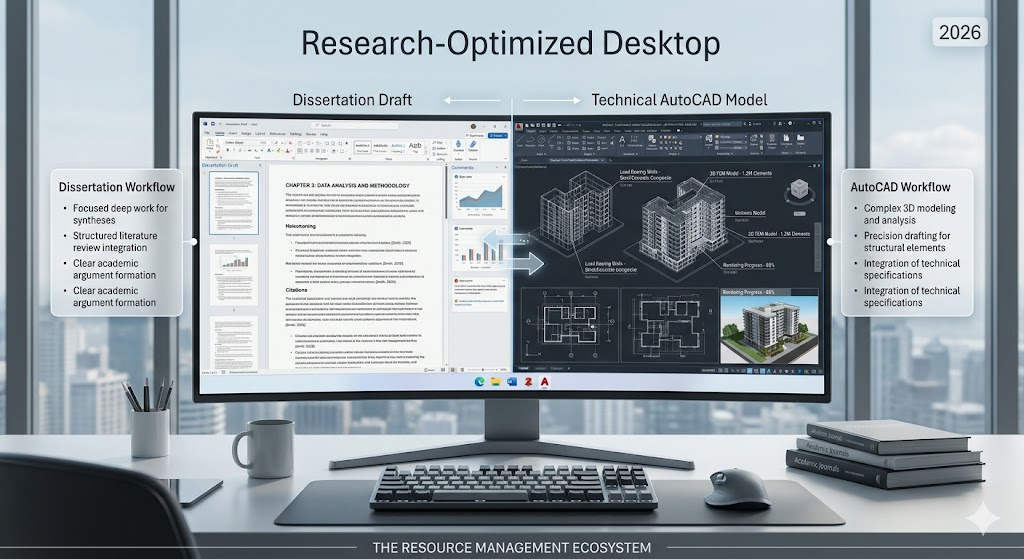
The Multi-Monitor “Flow” State
Data from the National Center for Education Statistics (2025) indicates that students using a dual-monitor setup with customized snap layouts report a 22% increase in research efficiency. This is particularly crucial for STEM and Architecture students who must balance high-resource software alongside their academic documentation.
However, even the most optimized desktop has a “bandwidth ceiling.” When the technical demands of a project—such as complex 3D rendering or structural analysis—exceed your machine’s or your own current bandwidth, professional autocad assignment help serves as an external processing unit. This allow students to maintain their project timeline while their local desktop remains dedicated to secondary research and theoretical analysis.
See also: Technology in Disaster Prediction
Data-Driven Performance: The 2026 Research Landscape
According to a 2026 survey of US-based R1 Universities, the average “Dwell Time” on a single academic task has dropped significantly due to notification fatigue. To combat this, the ultimate desktop must implement:
| Feature | Impact on Research | Productivity Gain (%) |
| Centered Taskbar | Reduced Eye Strain & Focus Alignment | 8% |
| Snap Layouts | Context Switching Efficiency | 15% |
| AI Search Indexing | Information Retrieval Speed | 30% |
The “EEAT” Factor in Academic Success
As we lean into customization, the “EEAT” (Experience, Expertise, Authoritativeness, and Trustworthiness) of our work remains paramount. High-level academic support today isn’t about shortcuts; it’s about Topic Authority. By delegating technical bottlenecks—like complex rendering or dissertation proofreading—to subject matter experts, students can focus on the “Experience” and “Expertise” components of their degree.
2026 Scholar’s Productivity Checklist
- [ ] UI: Centered Taskbar with 50% opacity (TaskbarX).
- [ ] Organization: Virtual Desktops separated by “Deep Work” vs. “Administrative.”
- [ ] Resourcing: Identify technical bottlenecks early (e.g., Drafting, Formatting).
- [ ] Health: Night light/Blue light filter active for late-night research sessions.
FAQ
Q: Does TaskbarX affect system performance for heavy software?
A: No, TaskbarX is extremely lightweight. It focuses on UI positioning rather than constant background processing.
Q: How does a clean desktop help with Dissertation writing?
A: It reduces “visual friction.” When you have fewer icons competing for your attention, your “Deep Work” phases last longer.
Q: Is using academic support services like MyAssignmentHelp ethical in 2026?
A: Yes, when used as a supplementary learning tool for expert guidance and technical proofreading.
Author Bio
Lachlan Miller is a Senior Academic Strategist at MyAssignmentHelp, specializing in the intersection of Educational Technology and Student Productivity. With over a decade of experience in the EdTech sector, Lachlan has helped thousands of students across the USA navigate higher education by optimizing their digital workflows.
References
- Department of Education (2025): Digital Literacy Standards for Graduate Research.
- Journal of Applied Cognitive Psychology (2026): The Effect of Desktop Environment on Long-form Composition.
- TEQSA 2026 Framework: Academic Integrity and Professional Support.