How to Match LED Strip Lights With the Right Power Supply for Different Projects
LED strip lighting can suit many different spaces, from home interiors and display areas to architectural features and commercial installations. However, choosing the strip itself is only one part of the process. The voltage, power consumption, installation environment, strip length, and power supply all need to work together.
A suitable combination helps maintain consistent brightness and reduces common installation problems. Before purchasing or installing LED strips, it is useful to understand the differences between strip types and how their electrical requirements affect the rest of the lighting system.
Understanding Different Types of LED Strip Lights
LED strips come in several configurations. SMD5050 strips are commonly used where stronger illumination and color options are required. A typical 5050 strip can contain 300 LEDs across five meters, with options for DC12V or DC24V operation. Some waterproof versions are available with IP65 or IP68 protection.
SMD3528 strips generally use less power. One example uses 300 LEDs over five meters and has a maximum consumption of 4.8W per meter. SMD2835 and SMD3014 strips provide other combinations of LED density, brightness, dimensions, and power consumption.
COB LED strips are another option. They produce a more continuous appearance because the LEDs are arranged to reduce visible individual light points. This can be useful when the strip itself is visible or when smooth illumination is important.
Neon-style silicone strips can also work for architectural applications, pathways, contours, signage, and decorative installations. A 24V silicone neon light with IP65 protection, for example, can provide additional protection for areas where moisture may be present.
What to Check Before Buying LED Strips in Bulk
Bulk purchasing requires more attention to specifications because replacing an unsuitable batch can affect an entire project. Start by confirming the operating voltage. Common low-voltage systems include 12V and 24V DC.
Next, check power consumption per meter and calculate the total length required. LED density also matters because two strips with the same physical length can have very different power requirements.
The installation location should also guide your choice. Indoor applications may use non-waterproof strips, while areas exposed to moisture may require IP65 or IP68 protection.
Cutting length is another practical consideration. Some 24V strips can be cut at six-LED intervals, while certain 12V strips can be cut at three-LED intervals. Understanding the cutting point before installation helps avoid unnecessary waste.
Calculating the Power Requirement
Calculating power requirements is straightforward. Multiply the strip’s wattage per meter by the total length.
For example, if a strip uses 12W per meter and you need five meters, the basic load is 60W. The power supply should be selected according to this requirement, with suitable capacity for reliable operation.
The calculation becomes especially important for longer installations. A supply that cannot handle the total load may cause unstable performance or reduced brightness.
The wiring and connections also deserve attention. Longer runs can experience voltage drop, particularly with 12V systems. A 24V system generally allows longer runs with less voltage drop under comparable conditions.
Choosing LED Strip Lights for Wholesale Projects
When selecting products for larger installations, consistency becomes important. Contractors, installers, distributors, and project buyers often need the same voltage, LED density, color temperature, dimensions, and protection level across multiple orders.
For buyers comparing the Best led strip lights wholesale options, technical specifications should be considered alongside quantity and application requirements. A product that works well for indoor decorative lighting may not be appropriate for an outdoor architectural project.
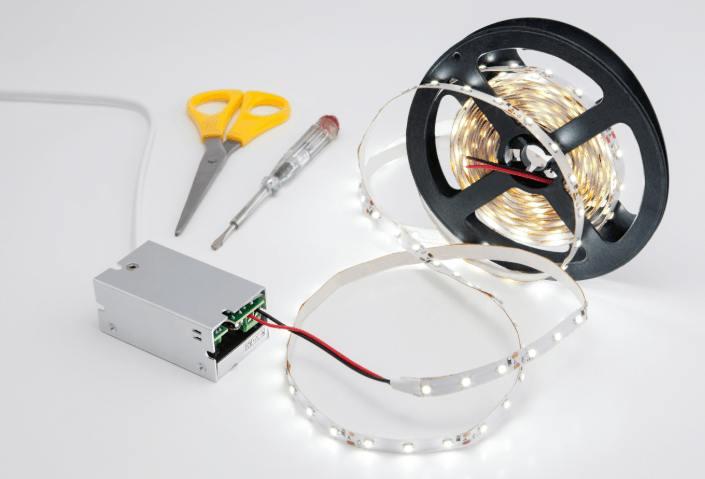
Packaging can also matter when purchasing in volume. For example, some LED strips are supplied in five-meter reels, making them easier to handle, store, and distribute during installation.
The Role of the Power Supply
The power supply converts the available electrical input into the voltage required by the LED strip. This makes voltage compatibility one of the first things to verify.
A 12V LED strip requires a suitable 12V DC supply. A 24V strip requires a 24V DC supply. Connecting a strip to an unsuitable voltage can cause poor performance or damage.
Controllers also need to be considered when using RGB or other color-changing strips. An RGB touch controller, for example, may support DC12V to 24V input and provide multiple color modes through PWM dimming. The controller’s load capacity should match the connected lighting.
Indoor and Outdoor Power Supply Considerations
The installation environment affects both the strip and the power supply. An indoor installation in a dry location may require different protection than an outdoor installation exposed to rain or humidity.
Waterproof LED strips can provide additional protection where moisture is expected. IP65 and IP68 products offer different levels of protection, so the required rating should be determined by the actual environment.
When choosing an LED Power Supply manufacturer, buyers should also consider voltage options, product specifications, technical support, delivery requirements, and compatibility with the intended LED system.
Common Mistakes to Avoid
Several mistakes appear frequently during LED installations.
Using the wrong voltage is one of the most serious. Another common problem is calculating only the strip length without considering its wattage per meter.
Installers may also overlook voltage drop on longer runs. In some cases, they select a power supply without considering ventilation or the surrounding temperature.
Waterproofing can also be overlooked. A waterproof LED strip does not automatically mean every component in the system can be exposed to water. Connections, controllers, power supplies, and wiring all need appropriate protection.
A Practical Selection Process
A simple selection process can make planning easier.
First, identify the required lighting effect and strip type. Then confirm the operating voltage and calculate total power consumption. After that, determine whether the installation requires waterproof or weather-resistant protection.
Check the cutting length and strip dimensions before installation. If a controller is required, verify its voltage and maximum load. Finally, select a compatible power supply with enough capacity for the complete system.
Shenzhen Dekingled Co., Ltd. was established in 2014 and operates from 4th Floor, Building C, SanMing Industrial Park, Shiyan Town, Bao’an District, Shenzhen, China.
See also: Peptide Companies That Say a Doctor Is Involved: How to Tell Which Ones Mean It
Building a Reliable LED Lighting Setup
Good LED lighting starts with matching the components correctly. The strip type, voltage, wattage, installation environment, controller, wiring, and power supply all influence the final result.
DekingLED’s range includes SMD, COB, RGB, silicone neon, and other LED strip options, along with different voltage and protection configurations. Its featured free-cutting 12V/24V COB LED strip can also address installations where flexible cutting requirements are important.
Taking time to compare specifications before installation can help you select a system that fits the project’s electrical and physical requirements.